Property Certificate in Lahore 2026: What Buyers Must Check
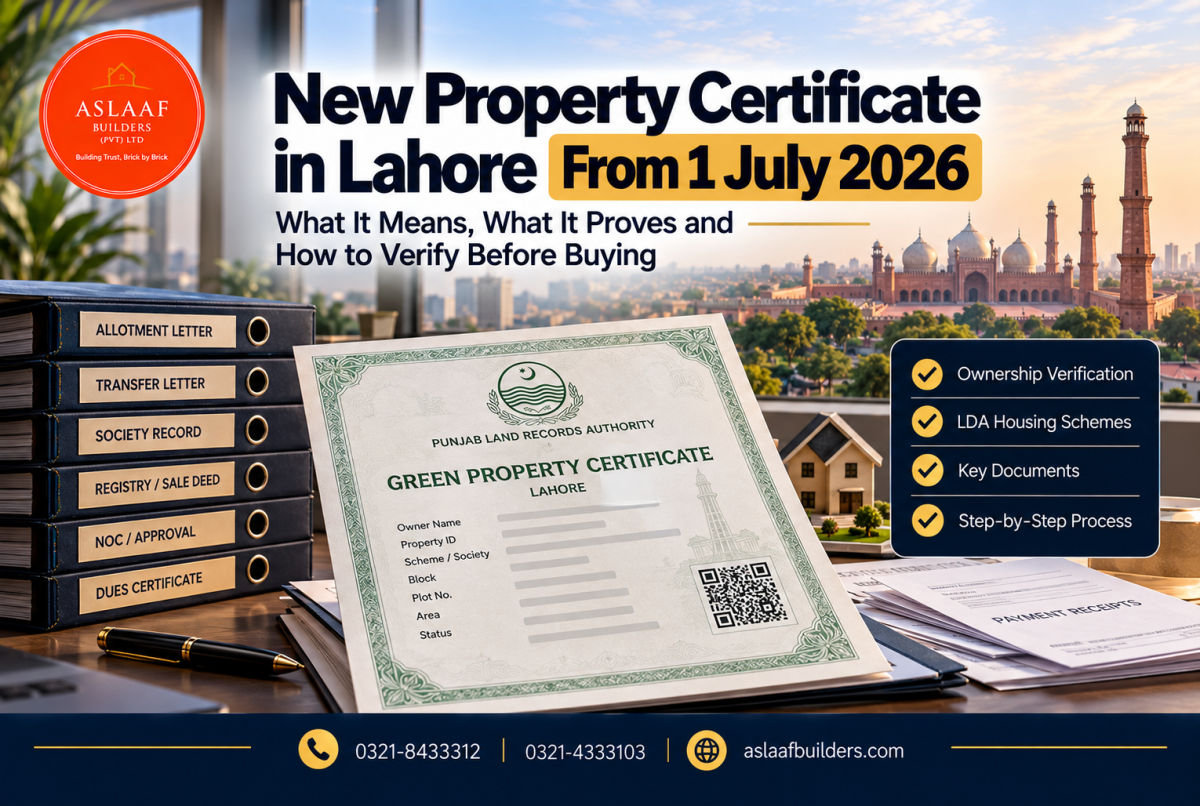
A seller has the original file, a society letter and years of payment receipts. Is that enough to prove the property is safe to buy? Not necessarily. From 1 July 2026, a new property certificate in Lahore became relevant to transactions in housing schemes falling within LDA’s jurisdiction. The certificate is meant to strengthen property ownership verification by linking society records to the Punjab Land Records Authority’s digital system. However, it should not be mistaken for a universal guarantee or a replacement for every existing document. Buyers must still verify the seller, plot, approval status, dues and transfer eligibility. This guide explains what the certificate means, where it fits and how to use it before paying token money.
Who Should Read This Guide?
This guide is essential for anyone planning to buy a plot, house or commercial property in a Lahore housing scheme. It is especially useful for first-time buyers, overseas Pakistanis, and investors buying through a representative. Existing owners should also understand the change before listing a property for sale. If a required certificate, ownership entry or society record is missing, the problem may delay the transfer after a buyer has already been found. The process may differ between private housing schemes, LDA schemes, cooperative societies, DHA and properties recorded directly within the provincial land system. Confirm the procedure for the specific property instead of applying one checklist to every Lahore transaction.
What Is the Property Certificate in Lahore?
The Punjab Land Records Authority describes its Green Property Certificate as an official document that verifies a property's ownership and legal status. LDA’s public notice states that a Property Certificate became required for housing schemes in Lahore from 1 July 2026. This development matters because many housing-scheme properties have traditionally depended on separate allotment, transfer and membership records maintained by individual societies. A digital certificate can provide another formal layer of ownership confirmation. It does not mean that a buyer can ignore the registry, mutation, allotment letter, transfer letter or society verification. Consider the certificate alongside the documents applicable to the property.
What the certificate may help establish
Depending on the property record and issuing process, the certificate may help confirm:
The recorded owner’s identity
The property’s identifying information
Its recognized legal or ownership status
The record available through the relevant authority
Whether the information presented by the seller matches the official system
A certificate is useful only when its details match the property being purchased exactly. Check the plot number, block, scheme, area, owner’s name and identity particulars for inconsistencies.
What the certificate does not automatically prove
A buyer should not assume that the certificate confirms every fact affecting the transaction. It may not, by itself, establish:
The current market value of the property
Whether all society installments are paid
Whether possession is open
The physical condition or location of the plot
Whether construction is permitted immediately
Whether litigation arose after the certificate was issued
Whether the seller has made another private commitment
Whether the society or specific project stage has the required approval
Whether every transfer charge and government tax has been paid
Treat the certificate as an important verification document, not a one-page substitute for complete due diligence.
Why This Change Matters for Lahore Property Buyers
The new requirement changes the questions a buyer should ask before paying a property token. “Do you have the original file?” is no longer enough. The stronger question is whether the complete documentary chain agrees across the seller, housing society, LDA and PLRA records.
Fake or duplicate documents become harder to rely on
Photographs of an allotment letter can be edited, and several dealers can circulate the same property. A digitally issued ownership certificate gives the buyer another official record to compare against the documents being presented. This does not eliminate property fraud. It makes contradictions easier to identify when the proper authority completes verification rather than relying on screenshots supplied by the seller.
Housing-scheme records gain another verification layer
A private society may maintain its own ownership and transfer records. The certificate requirement appears intended to create a stronger link between housing-scheme properties and Punjab’s formal land-record infrastructure. LDA’s website provides separate access to approved schemes, illegal schemes, regular schemes, application tracking, NOCs and verification-related services. Buyers should check the specific scheme or project stage rather than relying on the developer’s general marketing claims.
Overseas buyers gain a stronger control point
An overseas Pakistani may receive scanned documents through a relative or property dealer. The property certificate can become one condition in a written remote-purchase process. The buyer should still independently confirm the certificate, appoint a limited authority holder and use documented banking channels. A forwarded PDF is not enough if you haven't checked its authenticity and current status.
Property Certificate, Registry, Fard and Mutation Are Not the Same

Confusion between property documents creates serious risk. Each document performs a different function, and the required combination depends on how the property is legally recorded.
Not every transaction requires every document in this table. The purpose is to stop buyers from treating different records as interchangeable.
How to Verify Property in Lahore Before Paying Token Money
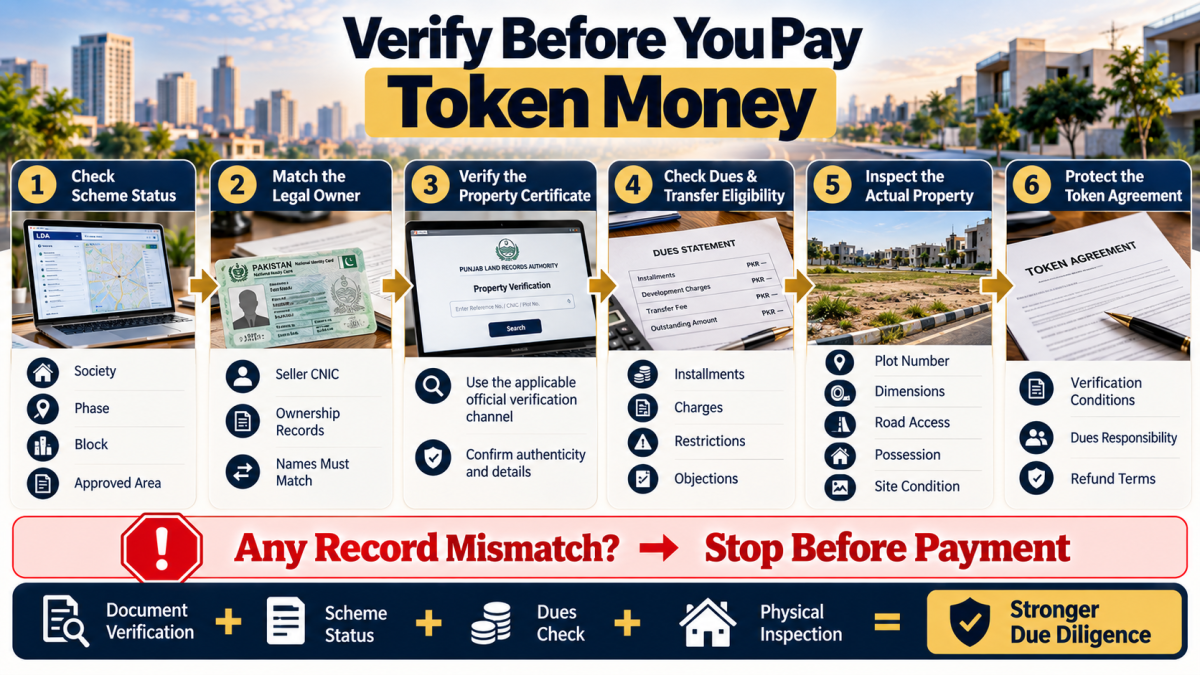
A safe property investment in Lahore should follow a controlled sequence. Completing verification after paying a non-refundable token reduces the buyer's bargaining power.
Confirm the housing scheme’s status
Search the relevant authority’s record for the exact society, phase and block. LDA separately lists approved, illegal and regular housing schemes on its official platform. Approval of a society’s name does not automatically prove that every extension, block or revised layout is approved. Match the offered plot with the approved area and plan.
Match the owner across every document
Compare the seller’s CNIC with the name appearing on the property certificate, allotment record, transfer letter, registry and relevant society record. If the seller is acting through an attorney or authority holder, verify the authorization, its scope and its continuing validity. Do not assume the person negotiating the deal is the legal owner.
Verify the certificate independently
Do not depend on a screenshot, WhatsApp attachment or QR image sent by the dealer. Use the official PLRA or applicable authority channel to confirm the document. PLRA also provides digital services for ownership records, Fard, mutation tracking, and property transfers. Use the service relevant to the property’s legal category.
Check dues and transfer eligibility
Ask the society or authority whether installments, development charges, penalties, transfer restrictions or other objections remain outstanding. A clear ownership certificate does not necessarily mean the property is financially ready for transfer. The written cost sheet should identify who will clear each outstanding amount.
Inspect the physical property
For a numbered plot, confirm its physical location, dimensions, road access, ground level, possession, and nearby land use. Compare the site with the official map or site plan. For a constructed property, review building approvals, completion documents, utilities, structural condition, and any unauthorized changes. Documentary ownership cannot reveal every physical problem.
The Token Receipt Must Protect the Buyer
The token agreement should reflect the certificate requirement. A buyer should not pay merely because the seller promises to “complete the certificate later.” The token receipt should state:
Buyer’s and seller’s full identities
Exact property description
Agreed purchase price
Token amount and remaining payment
Deadline for producing the required certificate
Independent verification condition
Scheme-approval and ownership conditions
Responsibility for dues and transfer charges
Refund terms if verification fails
Consequences of incorrect or concealed information
Date and place of the proposed transfer
Avoid vague wording such as “documents will be checked.” Name the documents and authorities involved.
Red Flags That Should Stop the Deal
A missing document does not always prove fraud, but pressure combined with inconsistent records should end the transaction until the issue is resolved. Stop and investigate when:
The seller refuses official property verification
Names differ between the CNIC and ownership records
The property certificate cannot be independently confirmed
The certificate describes a different plot or property area
Only cropped or blurred document photographs are provided
The society’s approval status is unclear
The property falls within an unapproved extension
Token money is demanded before document inspection
Payment is requested in an unrelated person’s account
The seller cannot explain the ownership chain
The price is substantially below comparable properties
Transfer eligibility depends on a verbal promise
A discounted price cannot compensate for uncertain ownership.
Conclusion
The new property certificate in Lahore can improve transparency, but buyers should use it as one part of a complete verification process. Confirm whether the requirement applies to the exact housing scheme and obtain the certificate through the proper authority. Then compare its details with the seller’s CNIC, registry, allotment or transfer documents, society record, approval status and dues position. Never release the full payment simply because one document appears genuine. Aslaaf Builders helps buyers examine Lahore property opportunities through current market information and practical verification checks. Follow Aslaaf Builders on Facebook, LinkedIn and X for property-market updates and responsible buyer guidance.
FAQs About the Property Certificate in Lahore
Is a property certificate compulsory in Lahore from July 2026?
LDA’s public notice states that a Property Certificate is required for housing schemes within the relevant Lahore jurisdiction from 1 July 2026. Confirm how the notice applies to your specific society and transaction.
Is the Green Property Certificate the same as a registry?
No. A property certificate verifies recorded ownership and legal status, while a registry or registered sale deed records a property transaction. One should not automatically be treated as a replacement for the other.
Can I check a property certificate online?
PLRA provides digital property and land-record services, but the available verification method may depend on the record and property category. Use only the official PLRA or relevant authority platform.
Does the certificate prove that a housing society is LDA approved?
Not necessarily. Check the exact society, phase, block and approved area through LDA’s approved-scheme records. Ownership verification and scheme approval answer different questions.
Should I pay token money before receiving the certificate?
Avoid paying a non-refundable token before you can verify the required ownership documents. If a conditional token is necessary, the receipt should require a refund when the certificate or other official verification fails.
Does the certificate confirm that all property dues are clear?
Do not assume so. Obtain a separate dues statement or No Demand Certificate from the relevant society or authority where applicable.
Can an overseas Pakistani verify property through a representative?
A properly authorized representative may assist with local verification, subject to the authority’s requirements. The overseas buyer should retain control of the property selection, price and payment approvals.


0 Comments