Does Solar Increase Property Value in Lahore? The 2026 Buyer Test

Solar can increase a Lahore home’s market appeal and justify a higher price, but the owner shouldn't expect to recover the full installation cost automatically. A buyer is not purchasing panels alone. The buyer is paying for verified electricity savings, reliable backup, safe installation, remaining equipment life and usable documentation. An older system with weak batteries, an undersized inverter or an unresolved prosumer agreement may add little value despite an expensive original invoice. Pakistan’s 2026 prosumer rules also make self-consumption more important. The grid bills imported electricity at the applicable consumer tariff, while it credits exported electricity under the prescribed energy-purchase arrangement. A house that uses more solar power during daylight may therefore offer stronger economic value than one designed mainly around exporting surplus units. This guide explains how to value a solar house for sale in Lahore without unquestioningly accepting the seller’s claimed premium.
Who Should Use This Guide?
This guide is useful for homeowners, property buyers, tenants and investors comparing solar-equipped houses with conventional properties. It is particularly relevant if you:
Plan to sell a house with rooftop solar
Want to buy a solar-powered home in Lahore
Are comparing two otherwise similar houses
Need to value an existing 5kW or 10kW system
Want battery backup during power interruptions
Are unsure whether a prosumer agreement continues after sale
Need to calculate a reasonable solar premium
Want to avoid buying outdated or unsafe equipment
The calculations are valuation tools, not guaranteed resale estimates. The actual premium depends on the house, buyer demand and condition of the installed system.
Why Solar Can Make a House More Attractive
A well-designed solar system can solve a practical household problem from day one. That immediate utility can make a property more competitive than a comparable house without solar. Potential buyer benefits include:
Lower daytime grid consumption
Protection against future tariff increases
Backup when batteries are installed
Reduced generator dependence
Existing panels, wiring and mounting structure
Less installation work after possession
More predictable household energy planning
Potential credit for eligible exported electricity
These benefits can shorten a property’s selling period or support a higher demand. However, a market advantage is not the same as a guaranteed rupee-for-rupee increase in value.
The Solar Premium Should Be Based on Savings
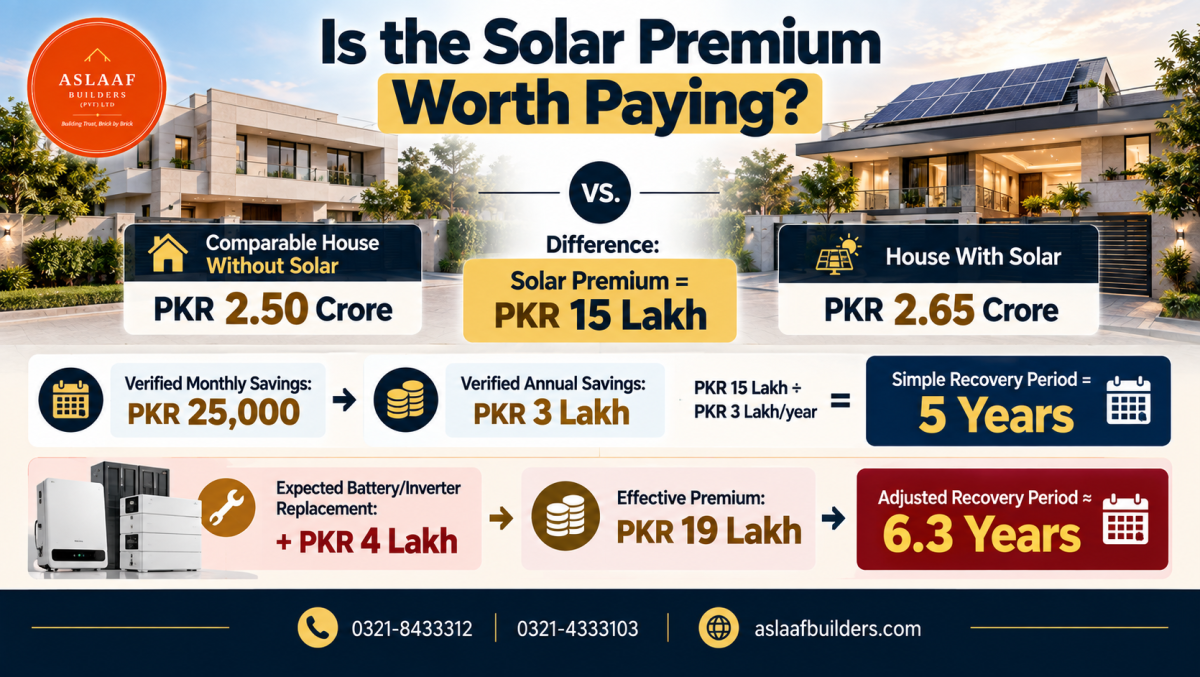
The cleanest way to assess a solar premium is to examine verified annual savings rather than the seller’s installation invoice. Suppose two similar houses are available:
Assume the seller provides 12 months of bills showing average savings of approximately PKR 25,000 per month.
Verified annual savings: PKR 3 lakh
Solar premium demanded: PKR 15 lakh
Simple premium recovery period: 5 years
A five-year recovery period may seem reasonable until you consider the equipment's condition. If the buyer expects to spend PKR 4 lakh on batteries or an inverter replacement, the effective premium becomes PKR 19 lakh, and the simple recovery period increases to about 6.3 years. This does not determine the property’s final value. It shows whether the additional asking price is supported by measurable benefit.
Installation Cost Is Not the Same as Resale Value
A seller may argue that PKR 15 lakh was spent on solar and therefore the property must be worth PKR 15 lakh more. That reasoning ignores depreciation and system quality. The resale contribution may be lower because:
Panels have already been used for several years
The inverter warranty may be close to expiry
Batteries lose usable capacity
Product prices may have fallen since installation
The system may be oversized for the buyer
Roof repairs may require removal and reinstallation
Export-credit rules may have changed
Documentation may not transfer automatically
Published 2026 vendor prices also vary significantly. Advertised 5kW packages range from roughly PKR 5 lakh for basic on-grid configurations to above PKR 10 lakh for hybrid systems with stronger backup specifications. Compare the installed components with current replacement cost rather than relying on an old receipt.
On-Grid, Hybrid and Off-Grid Systems Add Different Value
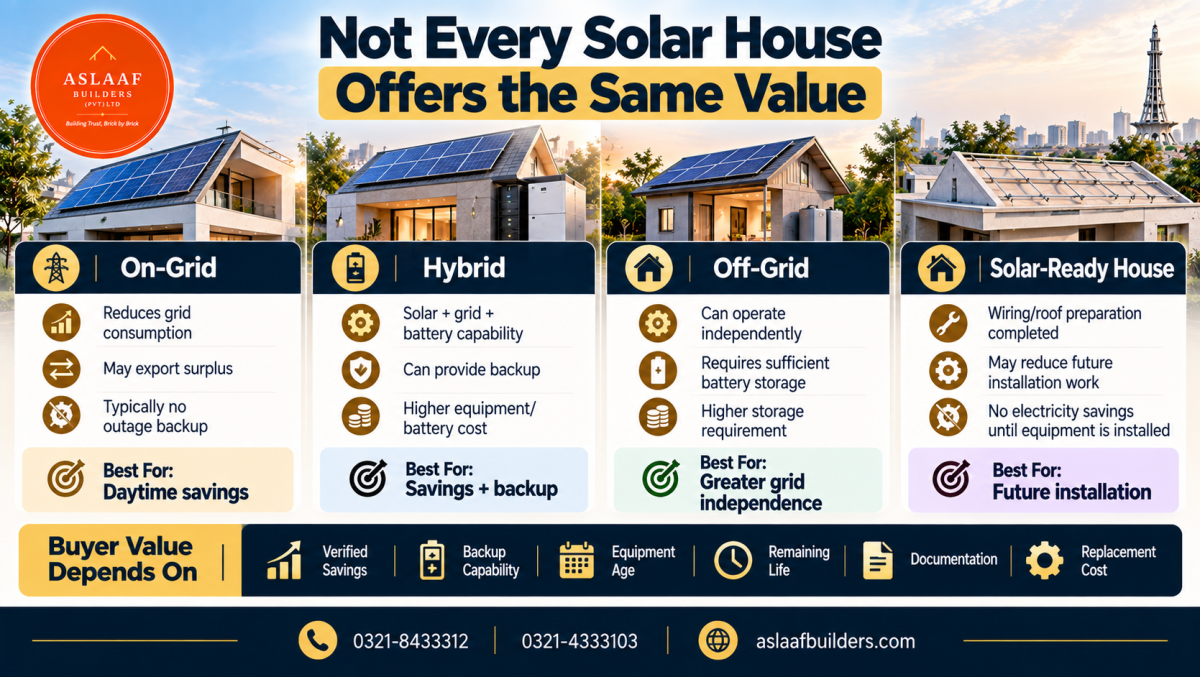
The word “solar” is too broad for property valuation. The system type determines what the new owner can actually do.
A buyer wanting backup may assign little additional value to an on-grid system that shuts down during an outage. Conversely, a household with reliable supply may prefer a lower-maintenance on-grid setup instead of paying for batteries.
What Changed Under Pakistan’s 2026 Prosumer Rules?
NEPRA’s 2026 regulations use a net-billing arrangement. The distribution company bills electricity supplied at the applicable tariff, while the prosumer is credited for exported electricity at the prescribed national average energy purchase price. The agreement term is five years and may be renewed by mutual consent. The rules also state that the applicant cannot assign the agreement without the distribution licensee’s prior written consent. The proposed new owner must assume the relevant obligations in writing. An August 2026 amendment further provides that distributed-generation facilities of 25kW or below do not require separate NEPRA concurrence; the relevant distribution licensee handles approval. For a Lahore property buyer, this creates four essential questions:
Is the system formally approved and connected?
When does the existing agreement expire?
What billing arrangement applies to this connection?
What procedure will LESCO require after ownership changes?
Don't pay a premium for “approved net metering” until you independently confirm the documents and current billing position.
Daytime Consumption Now Deserves More Attention
A seller may present exported units as the main benefit, but the household’s consumption pattern may matter more. Solar electricity used directly during daylight replaces units that would otherwise be purchased from the grid. The grid credits surplus production under the applicable purchase arrangement. A solar home may deliver stronger value when residents use significant electricity during the day for:
Air conditioning
Home-based work
Water pumping
Laundry
Kitchen appliances
Electric vehicle charging
Commercial or office activity
A mostly empty house that consumes electricity after sunset may depend more heavily on batteries or grid imports. Ask for both import and export history, not just total solar generation.
Documents a Solar-Home Buyer Should Request
Treat solar equipment as a separate asset in the property transaction. Request:
Original purchase invoice
Panel brand, model and wattage
Inverter brand, capacity and serial number
Battery specification and installation date
Product and quality warranties
Approved system capacity
Prosumer or interconnection agreement
Relevant approval or concurrence record
Recent electricity bills
Import and export readings
System-generation reports
Installer contact details
Maintenance and repair history
Earthing and protection documentation
The sale agreement should identify which panels, batteries, inverters and monitoring equipment are included. Otherwise, a dispute may arise if removable components disappear before possession.
Inspect the Roof Before Valuing the System
A working inverter screen does not prove that the installation is structurally or electrically sound. A qualified inspection should assess:
Roof leakage near mounting points
Rust or weakness in the mounting structure
Panel shading
Cable condition
Earthing
Breakers and surge protection
Inverter ventilation
Battery location
Signs of overheating
Panel damage or discoloration
Actual output against installed capacity
Safe access for maintenance
An unsafe installation can reduce property value because the buyer inherits correction costs and potential damage.
Does Solar Increase Rental Value?
Solar may support higher rent when the tenant receives a clear, measurable benefit. Its value depends on who pays the electricity bill and how savings are allocated. A landlord should clarify:
Whether electricity remains in the owner’s name
Who receives export credits
Whether solar is included in the rent
Who maintains the inverter and batteries
Who pays for negligent equipment damage
Whether the tenant can monitor generation
How abnormal bills will be investigated
Instead of demanding an arbitrary “solar rent premium,” compare the tenant’s expected total housing cost. A slightly higher rent may remain attractive if electricity spending falls by more. Browse current houses for rent to compare solar-equipped and conventional properties within the same location and size category.
When Solar Adds Little Property Value
Solar may not justify a meaningful premium when:
Electricity bills cannot prove savings
The system is not formally approved where required
Equipment ownership is disputed
Panels or inverter are near replacement
Batteries provide little usable backup
The roof requires major repair
The system is too small for the house
Installation creates safety concerns
The buyer’s usage occurs mainly at night
Agreement-transfer requirements remain unresolved
In these cases, the buyer should value the property independently and treat the solar equipment cautiously.
Conclusion
So, does solar increase property value in Lahore? It can, but the premium should reflect remaining economic benefit rather than the seller’s original spending. Compare the solar house with a genuinely similar non-solar property. Verify 12 months of bills, calculate annual savings, inspect the equipment and deduct expected replacement costs. Most importantly, confirm the prosumer agreement and ownership-change procedure before including export credits in your valuation. Aslaaf Builders helps buyers compare Lahore properties by location, condition, energy features, and long-term ownership cost. Follow Aslaaf Builders on Facebook, LinkedIn and X for researched property guidance, listings and real estate insights.
FAQs About Solar Property Value
How much value does solar add to a house in Lahore?
There is no universal percentage. Value depends on verified savings, system age, equipment quality, documentation, backup capability and buyer demand.
Should a buyer pay the full installation cost as a premium?
Not automatically. The buyer should compare current replacement cost, remaining equipment life and expected savings before accepting the demanded premium.
Does an on-grid solar system work during load-shedding?
A standard on-grid system generally shuts down when the grid fails for safety. Backup normally requires appropriate hybrid or off-grid equipment and batteries.
Can a prosumer agreement transfer with the property?
The 2026 regulations state that assignment requires the distribution licensee’s prior written consent. Confirm the current LESCO procedure before completing the property transfer.
Do systems of 25kW or below need NEPRA concurrence?
Following the August 2026 amendment, a prosumer facility of 25kW or below does not require separate NEPRA concurrence. The relevant distribution licensee provides approval.
Is a house with batteries more valuable?
It may be more attractive to a buyer needing backup, but you must assess battery age, chemistry, capacity, and replacement cost.
Which electricity bills should a buyer inspect?
Review at least 12 months where possible. Compare imported units, exported units, billing credits, seasonal consumption and any periods when the system was offline.
Can solar increase the rent of a Lahore house?
Yes, when the tenant receives dependable savings or backup. The tenancy agreement should clearly allocate electricity credits, maintenance and equipment responsibilities.


0 Comments