Affidavit vs Allocation File in DHA Lahore: Which Actually Costs Less?
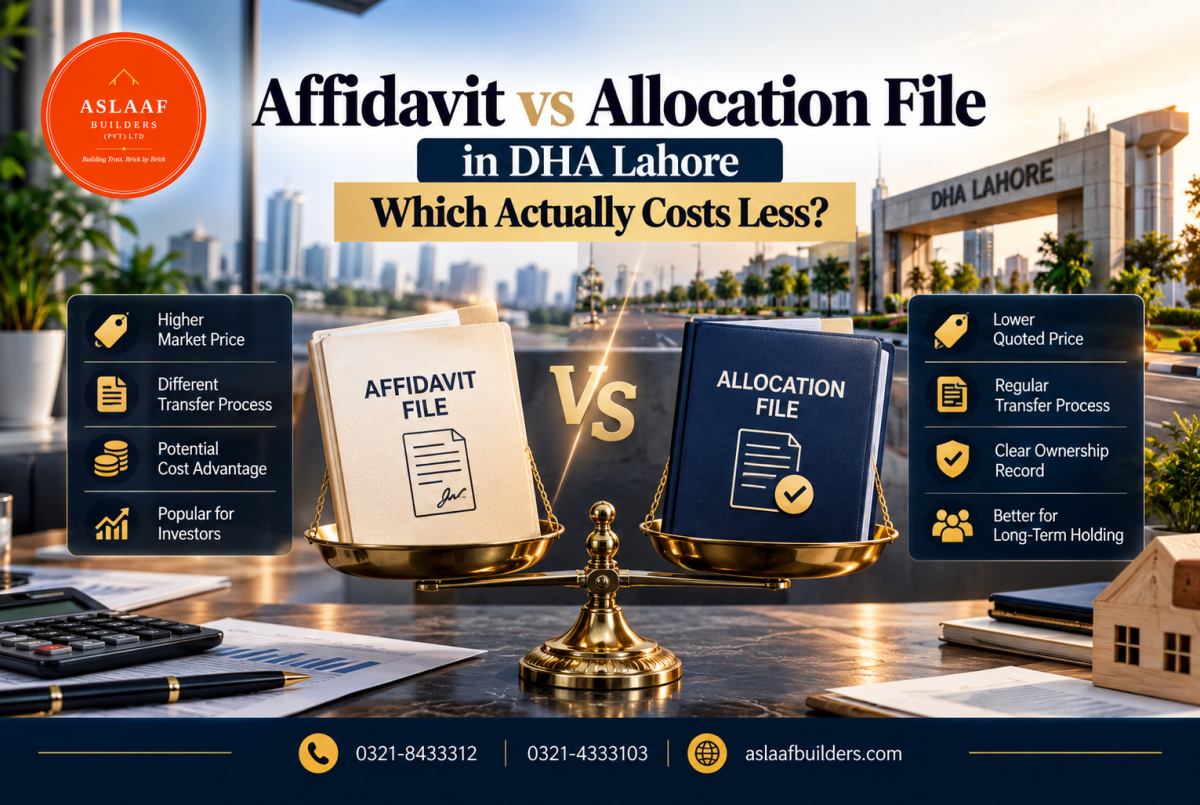
An affidavit file can cost PKR 2 lakh to PKR 6 lakh more than an allocation file of the same size in DHA Lahore Phase 10. Buyers often pay this premium after hearing that the affidavit will “save tax.” Others choose the cheaper allocation without calculating its transfer expenses. Both decisions can be wrong. This blog covers the affidavit purchase price plus applicable transfer costs vs. the allocation purchase price plus applicable transfer costs. This calculation determines which file genuinely costs less. This guide explains affidavit vs. allocation files in DHA Lahore, uses current Phase 10 rates as a real market example, and shows what buyers must verify before paying token money.
Who Should Read This Guide?
This guide is for anyone considering a DHA Lahore file before balloting or plot allocation. It is especially useful for:
First-time DHA file buyers
Investors comparing Phase 10 file categories
Overseas Pakistanis purchasing remotely
Buyers planning a short-term resale
Investors moving from one DHA file into another
Anyone quoted separate affidavit and allocation prices
The distinction matters most when the price gap is small. A file that looks expensive at the quotation stage may have a lower total acquisition cost once you include the applicable charges.
The Difference in Simple Terms
An affidavit and an allocation file may represent the same plot size in the same DHA phase, but they sit at different stages of the ownership and transfer process.
What is an Affidavit File?
In the DHA Lahore file market, an affidavit commonly originates through the land-acquisition process. DHA Lahore’s Land Branch explains that, after the relevant land documents, mutation, possession and No Demand Certificate processes are completed, the landowner or investor can receive an affidavit. When this affidavit is transferred to its first buyer through the applicable DHA procedure, the buyer’s ownership record proceeds toward allocation. Do not confuse an affidavit with an ordinary affidavit typed privately on stamp paper. The document must correspond with DHA’s official record and the person legally entitled to transfer it.
What is an Allocation File?
An allocation file has already passed into an identified owner’s name through DHA’s record. When that owner sells it again, the transaction generally follows the applicable regular transfer process. DHA Lahore’s published procedure requires an NDC and states that the seller and purchaser visit the Transfer Branch for a regular transfer. The buyer subsequently collects the relevant allocation, intimation or transfer letter after completing the documentation and payments. The allocation file is not inferior to ownership. It is simply at a later stage in the transaction.
Affidavit vs Allocation File at a Glance
The practical difference becomes clearer when you compare the two categories by transaction stage rather than marketing terminology.
These are general market distinctions. DHA’s current procedure and the exact file record must determine the actual transaction.
Current Phase 10 Affidavit and Allocation Rates
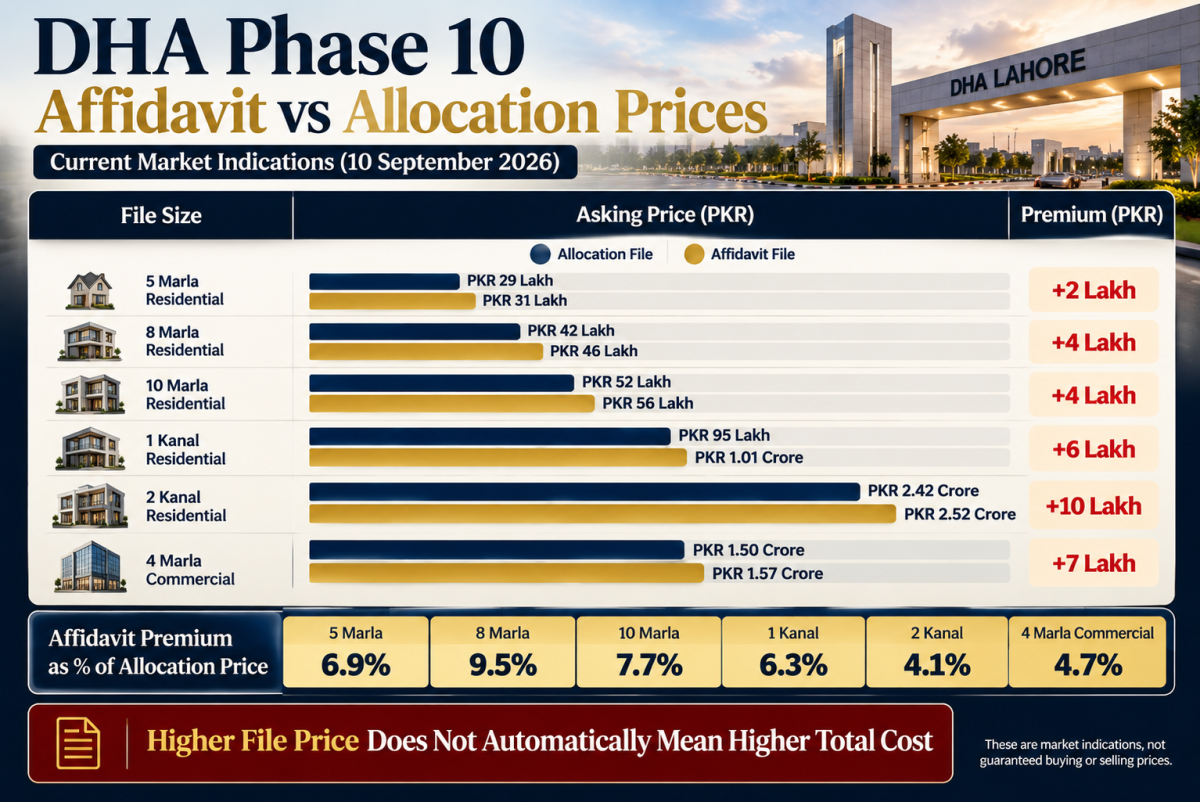
Phase 10 provides a useful example because both file categories trade actively. The following rate snapshot was published on 10 September 2026.
These are market indications, not guaranteed buying or selling prices. Affidavit availability, seller urgency and daily demand can change the spread. A second market source updated on the same date placed Phase 10 rates at PKR 31 lakh for a 5 Marla allocation and PKR 32 lakh for an affidavit. Its 10 Marla rates were PKR 51 lakh and PKR 54 lakh, while 1 Kanal rates were PKR 94 lakh and PKR 1 crore. The variation between the two sources proves an important point: a published rate is a reference, not an executable deal. Confirm whether a genuine seller is available at the quoted amount.
How to Calculate the Real Price Difference
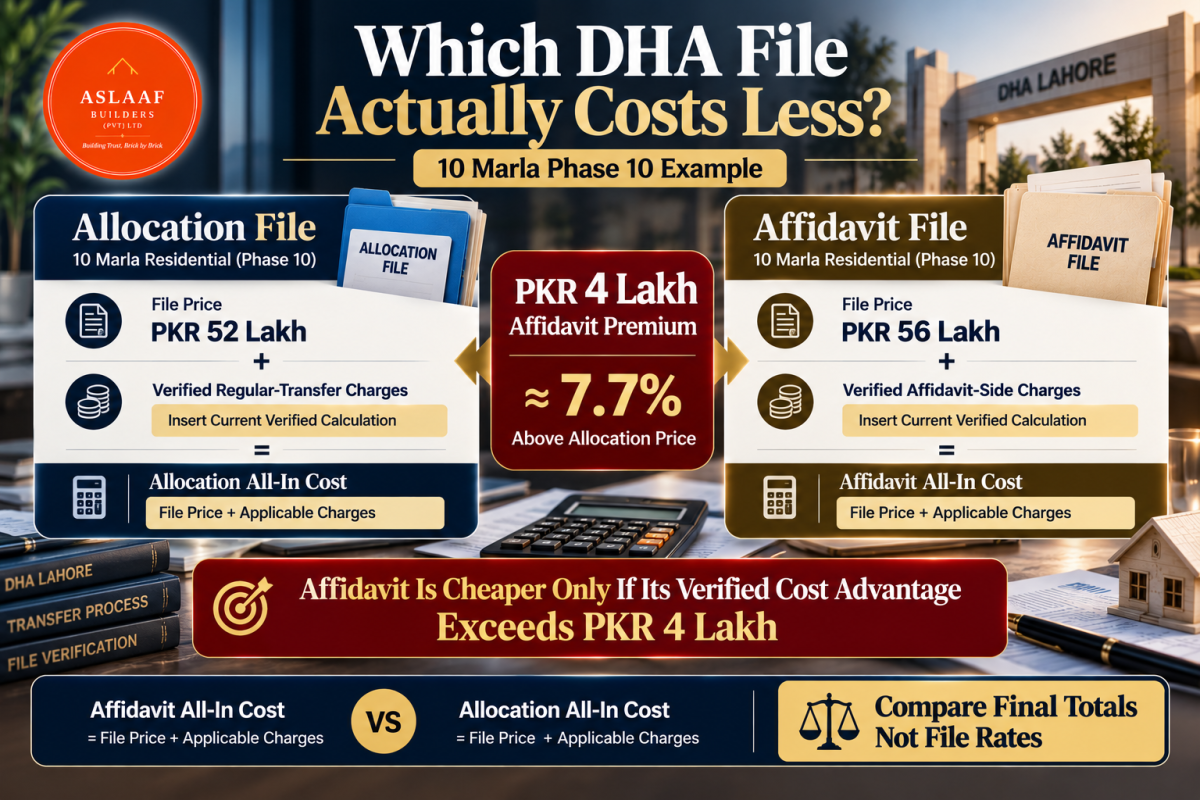
The affidavit premium alone does not tell you which file is cheaper. You must compare all-in acquisition costs. Use this calculation:
Affidavit all-in cost = affidavit deal price + verified affidavit-side charges
Allocation all-in cost = allocation deal price + verified regular-transfer charges
Then compare the two totals.
A 10 Marla Phase 10 Example
Suppose the available rates are:
10 Marla allocation: PKR 52 lakh
10 Marla affidavit: PKR 56 lakh
Affidavit premium: PKR 4 lakh
The affidavit is financially preferable only when its verified transaction-cost advantage exceeds the PKR 4 lakh premium. For example:
Do not let the dealer leave the “verified applicable charges” row blank. That row decides the transaction.
Why a Percentage Comparison Helps
The PKR 4 lakh premium on a PKR 52 lakh allocation rate equals approximately 7.7%. This means the buyer pays about 7.7% more at the purchase-price level for the affidavit category. The buyer should know exactly what procedural or financial advantage compensates for that premium. The same calculation produces approximate affidavit premiums of:
6.9% for the 5 Marla example
9.5% for the 8 Marla example
7.7% for the 10 Marla example
6.3% for the 1 Kanal example
4.1% for the 2 Kanal example
4.7% for the 4 Marla commercial example
These percentages are based on one market snapshot. They are not standard DHA premiums.
When an Affidavit File May Be the Better Purchase
An affidavit file can be commercially attractive when the premium is smaller than its verified all-in cost advantage.
The Premium is Reasonable
Suppose two genuine sellers are available and the affidavit costs PKR 2 lakh more. If the official transaction calculation shows an advantage greater than PKR 2 lakh, the affidavit may offer the lower total entry cost. The decision must use written figures. Statements such as “there is almost no expense on affidavit” are not a substitute for a current calculation.
You Want a Potentially Simpler First Transfer
Market practice distinguishes an affidavit’s initial transfer from a regular allocation transfer. Independent industry guidance notes that the affidavit stage can involve different attendance requirements from the subsequent allocation stage. Confirm the exact process with DHA Lahore, especially for overseas buyers, company purchases, representatives, or unusual ownership cases.
You Have Checked the Ownership Chain
A genuine affidavit should connect the landowner or investor, the underlying land-acquisition record and DHA’s documentation. The advantage disappears if the buyer relies on a photocopy, dealer custody, or an unverified document. The authority’s record not the paper’s appearance, must establish authenticity.
When an Allocation File May Be the Better Purchase
An allocation file can provide stronger value when its discount is larger than the additional cost of regular transfer.
The Discount is Substantial
If the affidavit carries a PKR 6 lakh premium but the verified transaction-cost difference is only PKR 3 lakh, paying for the affidavit would increase the total entry cost by approximately PKR 3 lakh. The allocation would be cheaper even though it involves the regular transfer route.
You Plan to Hold Until Balloting
A buyer intending to hold for several years may prefer a lower entry price, especially when both categories ultimately participate in the same project and plot-size pool, subject to DHA’s rules. Buying below the market’s affidavit premium can improve the investor’s cost position. However, the file must still be officially transferable and free from unresolved dues or objections.
The Allocation has Cleaner Immediate Verification
An allocation letter in the current owner’s name can make the ownership position easier for some buyers to understand. DHA Lahore also provides an official property-verification service that requires a copy of the relevant allocation, intimation, or allotment letter and identity documents. This does not remove the need for an NDC, seller verification and transfer appointment.
Today’s Affidavit Becomes Tomorrow’s Allocation
The affidavit premium is primarily relevant at the first transfer. After the affidavit is processed into the buyer’s ownership record, do not assume the same document can keep delivering the original category’s benefit through repeated sales. The next buyer may evaluate it as an allocation file subject to the regular transfer procedure. This creates an important investment question: Are you recovering the affidavit premium during your ownership period, or simply paying more for the first transfer? Short-term investors should calculate this carefully. If the market does not rise enough to recover the premium and selling expenses, the initial advantage may not create a profitable exit.
Do Not Confuse File Type With Project Quality
An affidavit does not make a weak DHA phase strong. An allocation does not make a good phase unattractive. The investment still depends on:
Expected balloting
Development progress
Location
Total file supply
Plot-size demand
Market liquidity
Holding period
DHA announcements
Entry price
Future installments or development charges
Broader property-market conditions
A correctly purchased allocation in a liquid category may outperform an overpriced affidavit bought during market hype.
Which Category is Easier to Resell?
Resale depends on the next buyer’s total cost, not merely the name written on the document.
Affidavit Files Can Attract Cost-Conscious Buyers
When affidavit inventory is limited and its cost advantage remains meaningful, buyers may accept a premium. This can improve short-term marketability. Advertised affidavit rates often rise faster than executable buyer offers. Scarcity should be confirmed through actual owner availability.
Allocation Files Attract Price-Sensitive Investors
Allocation files may appeal to buyers who want the lowest quoted entry price and are prepared to complete the regular transfer process. Resale can slow when buyers focus heavily on transfer expenses. A competitive asking price must reflect what the incoming purchaser will pay in total.
A Better Way to Negotiate the File Price
Do not begin by asking, “What is today’s rate?” Ask for four figures:
The seller’s final file price
All charges payable by the buyer
All amounts payable before the new letter is issued
The total amount required to complete the transaction
Then ask whether the quotation includes:
Dealer commission
Membership charges
Transfer fee
Government taxes and duties
Outstanding DHA dues
Urgent-processing charges
Documentation expenses
Any seller-side amount being shifted to the buyer
Two dealers can quote the same file rate and produce different total bills.
Warning Signs in an Affidavit Deal
Affidavit files are widely traded, but the word “affidavit” should never lower the buyer’s verification standard. Stop the transaction when:
Only a scanned affidavit is available
The original holder cannot be identified
DHA verification is refused
The document details do not match the file category
The seller demands payment before verification
The dealer will not explain the transfer route
The quoted rate is substantially below executable market offers
Payment is requested in an unrelated person’s account
The same document appears with multiple sellers
The buyer is promised a future allocation without written conditions
Transfer depends on an unsigned or incomplete document
A cheap unverified affidavit is not a discounted investment. It is an unresolved ownership risk.
Checks Before Buying Either File
Both categories require disciplined verification. Complete these checks before paying non-refundable token money:
Confirm the DHA phase, category and plot size
Inspect the original document
Match names and CNIC details
Obtain official property or file verification
Confirm whether the file is blocked, pledged or disputed
Check outstanding dues and objections
Verify the exact transfer route
Obtain a written transaction-cost calculation
Confirm who must appear before DHA
Check when the new ownership letter will be issued
Compare same-day executable rates
Record the token-refund conditions
Pay through documented banking channels
Keep copies of every receipt and submitted document
DHA Lahore states that its NDC process addresses outstanding objections and dues before a regular transfer. It also publishes transfer forms and separate procedures for overseas and outstation purchasers.
The Practical Verdict
Choose the affidavit when:
Its original record is independently verified
The seller is genuine
The premium is smaller than the confirmed cost advantage
The transfer procedure suits your situation
You understand that the first-transfer benefit may not repeat at resale
Choose the allocation when:
Its price discount exceeds the extra transfer cost
You prefer the existing ownership letter
The seller and buyer can complete the regular transfer
You plan to hold for the longer term
The file’s total acquisition cost is lower
Do not choose either category from the quoted rate alone.
Conclusion
In the affidavit vs allocation file DHA Lahore comparison, neither document is automatically cheaper. An affidavit normally commands a market premium because it sits before the first allocation stage and may carry a different transaction-cost structure. An allocation file usually offers a lower purchase price but follows the regular transfer process. Choose the option with the lower verified all-in cost. Before paying token money, obtain the file’s official verification, confirm the transfer route and request a written calculation covering the purchase price, DHA charges, government liabilities, membership expenses, dues and commission. If the dealer cannot show both totals, the comparison is incomplete. Aslaaf Builders helps investors compare DHA Lahore files using current market rates, ownership stages and complete transaction costs. Follow Aslaaf Builders on Facebook, LinkedIn and X for file-rate updates and practical Lahore property guidance.
FAQs About Affidavit and Allocation Files
Is an affidavit file always more expensive?
No. It often carries a premium, but demand and seller availability can change the spread. Compare genuine offers rather than assuming a fixed difference.
Is an allocation file safer than an affidavit?
Neither category is safe without official verification. An allocation has an identified owner in DHA’s record, while a genuine affidavit must connect correctly with the land-acquisition and first-transfer record.
Why do investors pay more for affidavit files?
Investors may pay a premium because the initial transfer follows a different process and may produce an all-in cost advantage. The premium is justified only when that advantage is verified.
Does an affidavit file remain an affidavit after purchase?
The initial affidavit is processed toward allocation in the buyer’s name. Buyers should not assume that its first-transfer treatment will repeat when they later resell it.
Which file is better for short-term trading?
The better option is the category with stronger genuine buyer demand and the lowest recoverable entry cost. A high affidavit premium can reduce short-term profit even when the file is easier to market.
Can an overseas Pakistani buy an allocation file?
DHA Lahore publishes procedures and forms for overseas purchasers. The buyer should confirm the applicable documentation, authorization and appearance requirements before committing funds.
How do I calculate which file is cheaper?
Add the negotiated price and every applicable transaction charge for each category. Compare the two final totals instead of comparing file prices alone.
Should I pay token money before DHA verification?
Avoid paying a non-refundable token before official verification. If a conditional token is necessary, the receipt should require a refund if ownership, transferability or file details cannot be confirmed.


0 Comments
osama shaikh
September 23, 2019 AT 09:33 PM
1. AMNA TOWER SCHEME 33, KARACHI, PAKISTAN 4 & 5 ROOMS LUXURY APARTMENTS AND SPACIOUS SHOPS AVAILABLE FOR SALE ! 0318-1011593, 0336-2788313 Spacious Shops Reserved car Parking High Speed Lift Children Play Area DETAILS VISIT: https://www.frontline.com.pk